

We Plan for Success, Yet We Prepare for the Unexpected: The Legal Foundations Startup Founders Often Overlook
Building a startup is often associated with innovation, growth, fundraising and scaling. Founders naturally focus on developing products, building teams and bringing ideas to market.
That is exactly how it should be.
But while founders focus on growth, one of the most important roles of legal advisers is to think beyond the immediate priorities of the business and identify the legal and commercial issues that may become critical later.
Because building a startup is not only about launching a product or raising capital. It is also about creating legal foundations capable of supporting growth, investment, change and uncertainty over time.
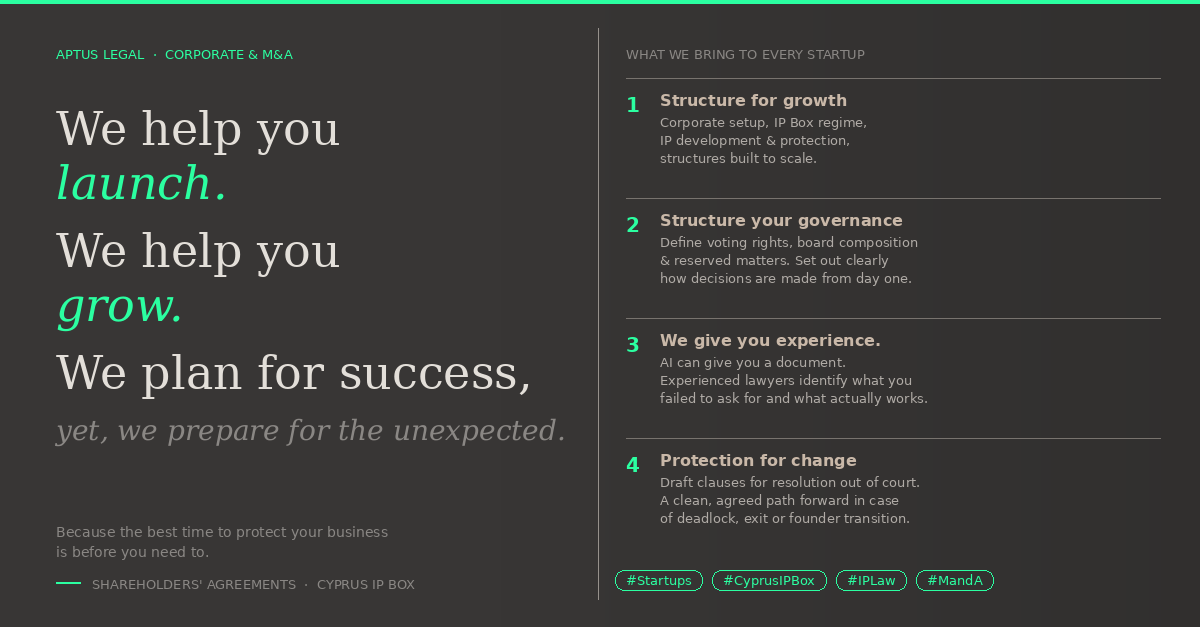
Structure for Growth
For many startups, legal structuring is often treated as secondary to product development and commercial growth. In reality, however, the legal and corporate structure established at the beginning of a business can have a significant impact on its ability to scale, attract investment and protect its value.
This is particularly relevant for startups seeking to benefit from the Cyprus IP Box regime.
The Cyprus IP Box regime is not simply a tax exercise. Proper implementation requires the right legal and corporate structure from the outset, including clarity around:
the intellectual property being developed;
who is actually developing it;
where the development activities take place;
ownership of the intellectual property rights;
confidentiality and protection measures; and
the company’s operational structure.
Founders are often surprised to discover that intellectual property ownership is not always as straightforward as expected. Developers, consultants and external contractors may contribute to the creation of software, platforms or other qualifying intellectual property without the company having sufficiently robust contractual protections or intellectual property assignments in place.
These issues may not appear problematic during the early stages of a business. However, they frequently become critical during fundraising rounds, investor due diligence or strategic transactions.
Structure Your Governance Early
Another area founders frequently underestimate is governance.
At the beginning of a startup journey, founders are usually aligned in vision, motivation and long-term expectations. Difficult scenarios are rarely discussed because everyone is focused on growth.
But businesses evolve. Priorities change. Relationships change.
A well-drafted shareholders’ agreement is therefore not simply a legal formality. It is often the framework that allows a business to continue operating effectively when disagreements or unexpected situations arise.
The conversations founders often avoid — or simply do not think about — at the beginning are frequently the ones that matter most later:
Who controls key business decisions?
What happens if a founder wants to exit?
How are deadlocks resolved?
What happens if visions or cultures no longer align?
Can shares be transferred freely?
What happens if one founder stops contributing to the business?
How is the company protected if relationships break down?
Good governance documents do not exist because founders expect disputes. They exist because businesses require clarity, predictability and continuity in order to grow sustainably.
In practice, businesses with strong legal foundations are significantly more likely to navigate difficult situations through agreed mechanisms and commercially sensible outcomes rather than destructive disputes.
Experience Matters
Many founders today also turn to AI-generated documents and online templates in an effort to reduce legal costs during the early stages of a business.
Technology is undoubtedly changing the legal industry, and AI tools can assist with producing draft documents or standard clauses.
However, startup structuring is rarely a standard exercise.
Effective legal structuring requires understanding founder dynamics, balancing commercial interests, anticipating future risks and assessing how decisions made today may impact fundraising, governance, intellectual property ownership and exit strategies later.
Templates and AI tools can generate documents. They cannot replace legal judgement, experience or commercial insight.
The value of experienced legal advisers is not simply drafting documents. It is identifying the issues founders may not yet see and helping structure businesses in a way that protects both growth and long-term sustainability.
Protection for Change
One of the most important things founders can understand is that good legal structuring is not pessimistic. It is practical.
Planning for potential disagreement, founder exits or governance challenges does not mean expecting failure. It means ensuring the business can continue operating effectively if circumstances change.
The strongest startups are not necessarily the ones that never face challenges. They are often the ones that prepared for those challenges early.
The best time to protect a business is before problems arise.
Founders should focus on building, innovating and growing.
The role of experienced legal advisers is to ensure the legal foundations supporting that growth are strong enough to withstand change, investment, scale and uncertainty over time.
How Aptus Legal Can Help
Whether you are establishing a new startup, seeking to benefit from the Cyprus IP Box regime, preparing for investment, or reviewing your governance arrangements, obtaining the right legal advice at an early stage can help avoid costly issues later.
At Aptus Legal, we advise founders and technology businesses on corporate structuring, shareholders' agreements, intellectual property ownership and protection, investment readiness, commercial contracts and ongoing legal matters throughout the growth journey.
If you would like to discuss your business or legal requirements, please contact us at info@aptuslegal.com.